
Reading time: 7min
Why choose natural materials for the home?
Our homes are filled with objects we use every day without really thinking about them: a coaster on the table, a basket near the entryway, a desk mat, a tissue box cover, a pet bed at the foot of the sofa.
Taken individually, these objects may seem secondary. Yet they often shape the real experience of home. They are the objects we touch, move, see every day, and that slowly begin to influence the atmosphere of a space.
For a long time, many everyday objects have been designed to be produced quickly, replaced easily, and purchased at a low cost. Plastic, synthetic foams, artificial textiles, and composite materials have taken up a large place in our interiors. These materials are practical, accessible, and of course, they have their purpose. But they have also changed our relationship with things.
Many objects have become temporary. We buy them quickly, replace them easily, and forget them almost as fast.
It is in this context that natural materials are slowly finding their place in the home again. Not out of nostalgia, but because they answer a need that feels increasingly clear: the need to live with more intention.
Natural materials have a different presence
A natural material does not behave like a synthetic material. Wood, wool, stone, linen, cotton, leather, or cork each have their own texture, density, variations, and way of aging.
They are not perfectly uniform. They are not completely fixed. They often carry subtle traces of their origin: a grain in the wood, a variation in the color of wool, an irregularity in a fiber, a nuance in stone.
These details are not necessarily flaws. They are often what make a material feel alive.
In a home, this presence changes something. Natural materials bring a form of warmth, even when used in very simple objects. They make a space feel less cold, less standardized, less interchangeable.
They remind us that a home is not just a setting. It is an environment we live in.
Natural does not automatically mean durable
It is important to say this clearly: a natural material is not automatically a good material.
Everything depends on how it is chosen, transformed, used, and maintained. A poorly designed natural object can be fragile. On the other hand, a durable object may sometimes contain a synthetic component when it serves a specific function.
The point is not to oppose all natural materials to all synthetic materials. The point is to ask a better question: what is the right material for this use?
That question should guide the design of an object.
A good material should not be chosen only for its appearance. It should be chosen for what it allows the object to do, how it ages, how it can be cleaned, how it transforms, and how it continues to exist in the home.
Durability does not come from the material alone. It comes from the relationship between material, function, and design.
Everyday objects deserve to be better considered
We often talk about design when it comes to larger objects: a chair, a table, a lamp, a sofa. But daily life is also made up of smaller, quieter, sometimes more modest objects.
Yet these are the objects that support our most repetitive gestures: placing down keys, protecting a table, organizing a desk, storing a blanket, or creating a resting space for an animal.
These gestures may seem simple, but when they are well supported, they make a home feel more fluid, calmer, and more pleasant to live in.
That is why everyday objects deserve to be designed with care, too. They should not only serve a function. They should age well, feel good to the touch, integrate naturally into a space, and have a real reason to exist.
In an era of temporary objects
We live in a time where many objects are designed to pass quickly through our lives. Trends change quickly, collections are constantly renewed, and some objects are replaced before they have even truly aged.
This logic has consequences. It pushes us to accumulate, replace, and consume without always choosing carefully.
Natural materials offer a different rhythm. They invite us to slow down, observe, and choose with more attention.
An object made from a natural material does not need to be spectacular to have value. Its value can come from its simplicity, its function, its texture, or its ability to remain relevant over time.
Choosing a durable object is not only about choosing something that resists wear. It is also about choosing something we will want to keep.
The beauty of what ages well
One of the greatest qualities of natural materials is their relationship with time.
Some synthetic materials can visually deteriorate as they age: they yellow, crack, deform, or quickly lose their original appearance. Natural materials often evolve differently.
Wood can deepen in tone. Leather can soften. Wool can show subtle marks. Linen can become more supple with use.
These transformations are part of the life of the object. They tell the story of how it has been used.
It is a different way of thinking about durability. A durable object is not necessarily an object that stays perfectly new. It is an object that continues to be beautiful, useful, and relevant, even when it carries traces of everyday life.
Why wool has a special place
Among natural materials, wool holds a very special place.
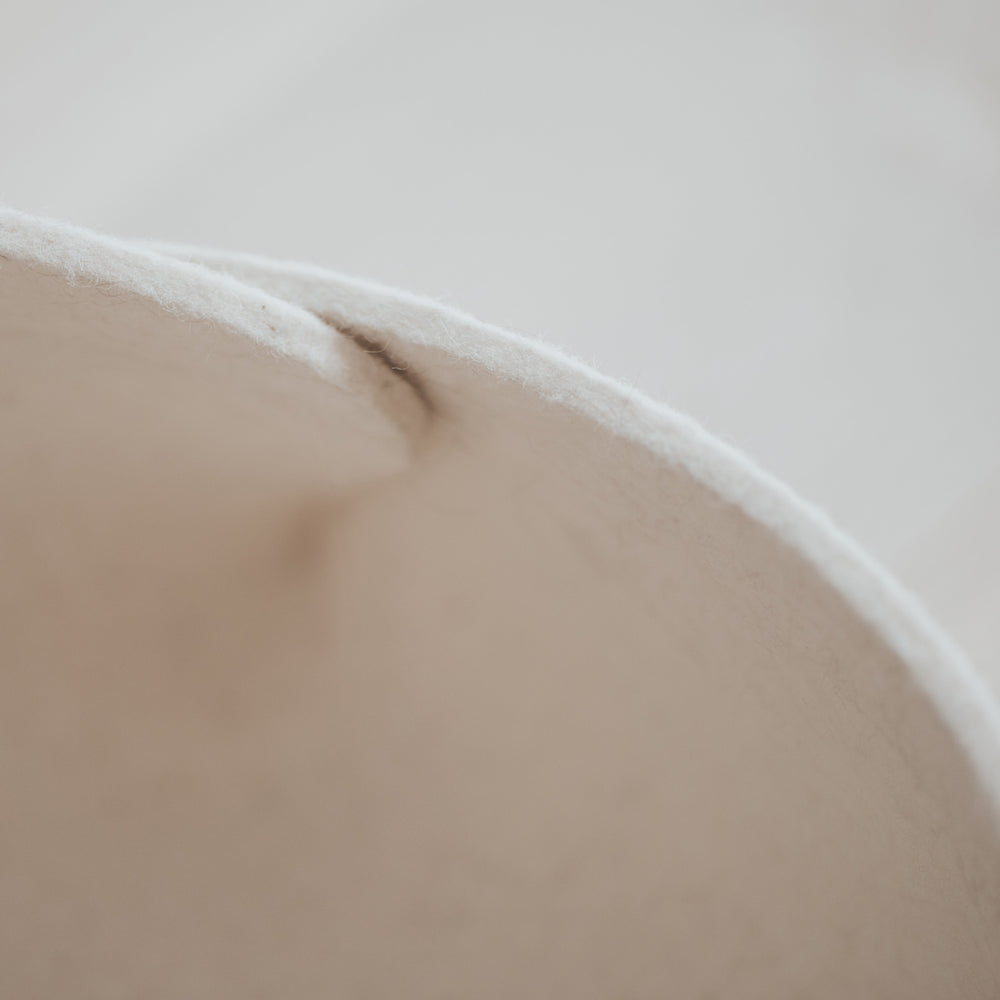
It can be both textile and structural. It can be soft, resistant, warm, breathable, and technically performing. In the home, wool can take many forms: rugs, blankets, felt, baskets, accessories, table objects, or work surfaces.
Wool has a quiet but strong presence. It softens spaces without weighing them down. It creates a sense of comfort without necessarily adding pattern or color. It is also a material we instinctively associate with warmth, rest, and protection.
That is one of the reasons it interests us so much at MATT™. Not only for how it looks, but for what it allows us to create: simple, natural, durable objects that are deeply connected to everyday gestures.
What inspires MATT™
At MATT™, we create everyday objects designed for the home, for animals, and for the simple gestures that shape daily life.
Our approach always begins with a question: why should this object exist?
Before drawing a shape, we seek to understand the use. Where will the object be placed? How will it be handled? How will it age? What material truly suits its function?
This reflection is what leads us to prioritize natural materials when they respond to the needs of the object.
For our Animal Collection, we use high-density industrial wool felt, chosen for its structure, resistance, and ability to support daily use. For our Home Collection, we use merino wool felt, selected for its refined feel, touch, and natural presence in the space.
Two different materials. Two different uses. One shared intention: to create useful, durable objects that integrate naturally into the home.
Living with more intention
Choosing natural materials for the home does not mean rejecting everything modern. On the contrary, it means choosing more consciously.
It means understanding what we buy. Looking at objects differently. Asking whether they deserve a place in our daily lives.
In a time surrounded by synthetic, fast, and often temporary objects, natural materials bring us back to something more essential: matter, touch, time, use, and the relationship between an object and the home.
And perhaps this is where another way of living begins: not with more objects, but with better ones.
A final thought
The most important objects in a home are not always the most visible.
Sometimes, they are the simplest ones. The ones we use without thinking. The ones that support our gestures. The ones that make everyday life feel softer, more fluid, and more natural.
That is why materials matter.
Because an object is never only a shape. It is a material we touch, live with, and keep.