
Reading time: 9min
Why has wool stood the test of time?
Long before polyester, nylon, and synthetic foams, there was wool.
For thousands of years, this fiber has accompanied humanity across climates, cultures, and uses. It can be found in clothing, blankets, rugs, technical textiles, and many everyday objects. Today, despite the arrival of hundreds of new materials, wool continues to hold a place of its own.
Why?
When a material endures for centuries, it is rarely because of tradition alone. It is because its properties continue to meet real needs, often with a balance that few other materials achieve as naturally.
At MATT™, this is precisely what led us to take an interest in wool. Not simply because it is an ancient material, but because it remains surprisingly relevant today.
A fiber designed by nature
Unlike synthetic fibers made from petroleum-based polymers, wool is a renewable animal fiber obtained from sheep that are shorn as part of their regular care.
Its primary function is simple: to protect the animal from cold, heat, wind, rain, and changes in humidity. To accomplish this, nature developed a fiber that is far more complex than it first appears.
Under a microscope, each wool fiber reveals a structure made up of several layers, a surface covered in tiny scales, and a natural crimp that directly influences its mechanical and thermal properties.
In other words, even before it is transformed into fabric or felt, wool already possesses a highly sophisticated architecture. It is a natural fiber, but also a technically remarkable material.
Wool does not produce heat
This is probably one of the most common misconceptions: wool does not create heat. Instead, it helps retain it.
Its effectiveness is largely due to the natural crimp of its fibers. Because they are not perfectly straight, wool fibers trap many small pockets of air. Air, in turn, slows down heat transfer.
When temperatures are cooler, body heat is better retained. When conditions are warmer, the structure of the fiber remains breathable and helps reduce an overly stifling sensation.
This is known as thermoregulation. Wool does not actively heat the body; rather, it helps create a more stable and comfortable thermal environment.
This ability may also help explain why many cats and dogs seem to enjoy natural fibers at different times of the year. They are not necessarily seeking the greatest possible warmth, but often a resting space that offers better thermal comfort.
A fiber that naturally manages moisture
Another term often associated with wool is hygroscopic.
This simply means that the fiber can absorb some of the water vapor present in the air and gradually release it as conditions change. Unlike many materials where moisture remains mainly on the surface, wool can temporarily retain part of it within the fiber itself.
Why is this useful?
Because a material that manages changes in humidity more effectively can help create a more stable and comfortable environment around it. This is one of the reasons wool has long been used in technical clothing intended for changing or demanding conditions.
This property does not make wool waterproof, nor does it mean it can never become damp. It simply allows the fiber to respond differently to water vapor and changing ambient conditions.
Why wool often feels fresh for longer
When we think about odors, we often assume they come directly from the material itself. In reality, persistent odors are frequently associated with moisture, residue, and the development of microorganisms.
Because wool manages water vapor differently from many synthetic fibers, it can retain a fresher feel for longer between cleanings. Its structure can help limit the accumulation of moisture directly on the surface, which may reduce the conditions that contribute to persistent odors.
This does not mean wool never needs to be cleaned. Like any material used every day, it requires care suited to its use. Its advantage lies instead in the way its natural structure responds to moisture and everyday wear.
Lanolin: wool’s first layer of protection
In its raw state, wool is coated with a natural wax called lanolin. Produced by sheep, this substance helps protect their fleece from moisture and the elements.
During wool processing, much of the lanolin is removed to clean the fibers before they are made into textiles or felt. Depending on the type of wool and the process used, small amounts may remain.
Lanolin does not explain all of wool’s properties on its own. It does, however, remind us that long before wool became a material used in our homes, it was already part of a highly effective natural protection system.
Is wool a hygienic material?
This is a common question, and one that is often surrounded by misconceptions.
Natural fibers are sometimes perceived as more difficult to care for than synthetic materials. In reality, this depends largely on the type of fiber, how it has been transformed, how it is used, and how it is cleaned.
Wool has long been used in technical clothing, blankets, furniture, and other applications where comfort, durability, and moisture management are important. Its structure can help create conditions that are less favorable to persistent odors than certain materials that retain more moisture at the surface.
It is important to remain precise, however: this does not mean wool is “antibacterial” in the medical sense, nor that it requires no care. Like any material, it must be cleaned according to its use.
Its value lies instead in the natural balance it offers between breathability, moisture management, and comfort.
Is wool fragile?
Because it is natural, wool is sometimes seen as delicate. In reality, its durability depends greatly on how it is transformed.
An ultra-fine merino wool sweater and a high-density industrial wool felt may have very little in common beyond their origin. Their thickness, density, structure, and long-term behavior are completely different.
At MATT™, products designed for pets are made from high-density natural wool felt, selected for its structure, durability, and ability to maintain its shape through everyday use.
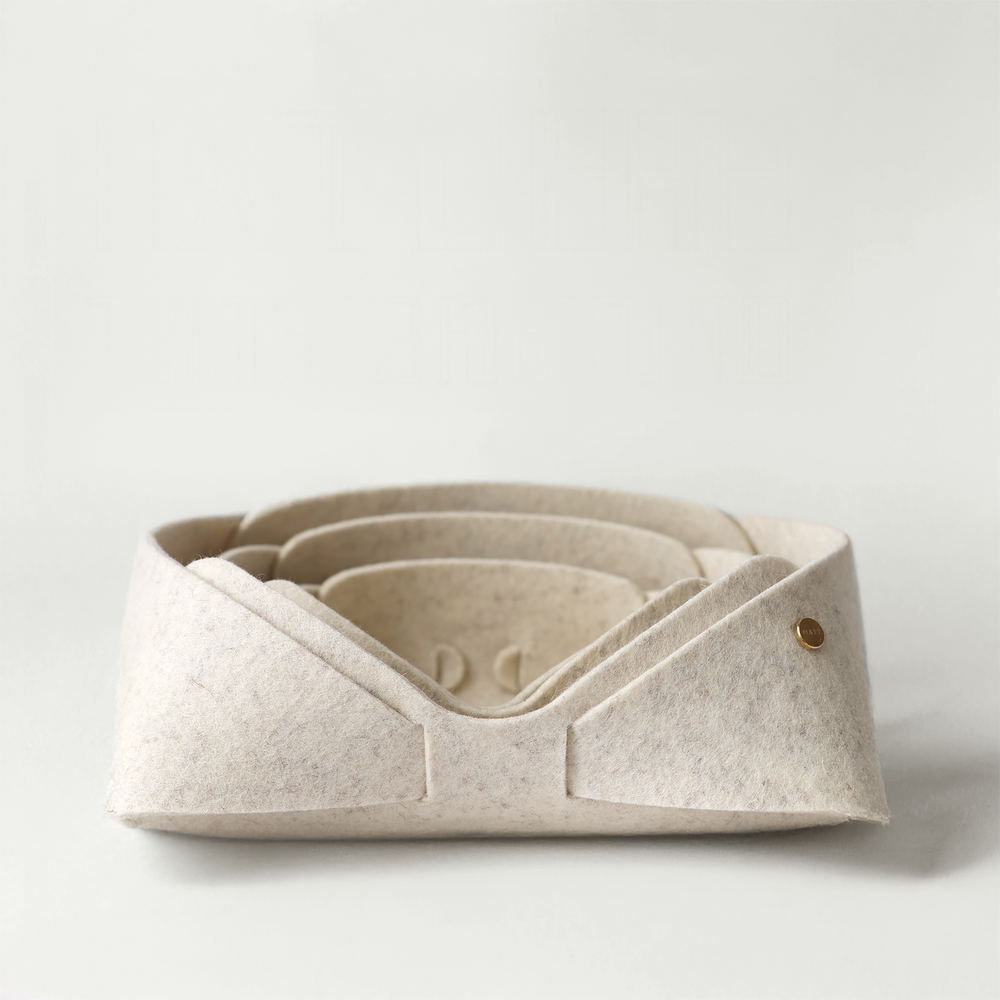
Objects in our Home Collection are made from merino wool felt, selected for its refined feel, the precision of its cuts, and its natural presence in the home.
Not all felts are the same. Their performance depends on factors such as fiber quality and composition, density, thickness, and the manufacturing process used.
That is why it is more accurate to speak about the properties of a specific felt than to generalize based on the word “wool” alone.
Why do we continue to use wool?
Because few fibers naturally combine so many qualities within a single material.
Wool can contribute to thermal insulation, remain breathable, manage some ambient moisture, recover from certain types of deformation, and offer a warm, tactile texture. It also comes from a renewable resource when produced and processed responsibly.
Modern materials have important qualities of their own and may be better suited to certain applications. Wool is therefore not automatically the best solution for everything.
It continues to hold a special place, however, because it offers a rare balance of technical performance, comfort, natural presence, and durability.
That is precisely what led us to choose it.
What this material teaches us
Wool reminds us that a good material can never be reduced to a single property.
Its real strength comes from the relationship between all of its qualities: its structure, its ability to manage temperature and moisture, its resilience, its texture, and the way it ages.
Understanding a material is not simply knowing what it is made from. It also means understanding how it responds, why it is suited to certain uses, and why it continues to be used generation after generation.
At MATT™, we believe the best objects always begin with this kind of reflection. Before designing a form, we first seek to understand the material and the function it needs to serve.
What inspires MATT™
When we began designing our objects, we did not look for the most popular material or the one that followed the latest trend.
We looked for the material that best responded to the behaviors and uses we observed, both in animals and in the home.
Wool emerged naturally, not because it is traditional, but because its properties remain relevant in very contemporary applications.
For our pet baskets, we chose high-density wool felt, capable of providing a stable structure while preserving the natural and tactile qualities of the fiber.
For our home objects, we use merino wool felt, selected for its refined touch, precision, and ability to integrate naturally into contemporary interiors.
Two different felts for two distinct families of use.
Because good design is not about using the same material everywhere. It is about choosing the right material for the right function.
A final thought
We sometimes assume that innovation must mean replacing what already exists.
Yet some of the most effective solutions are also among the oldest.
Long before synthetic fibers appeared, nature had already developed a material capable of protecting, insulating, breathing, and adapting to changing conditions.
Understanding wool may also mean recognizing that progress does not always come from inventing something new.
Sometimes, it comes from looking differently at something that was already working remarkably well.
Related articles
- Understanding industrial wool felt
- How wool naturally regulates temperature
- Why natural fibers age differently from synthetic fibers
- Why cats seem naturally drawn to wool
Related products
- Pet Collection
- Home Collection
- MATT™ Basket
- Wool felt scratching mat
- Wool felt desk mat
- Wool felt coasters
About MATT™
MATT™ is a brand founded by architect Kim Landry.
Through The MATT™ Journal, we explore animal behavior, natural materials, and thoughtful design to better understand what inspires each of our objects.
We believe the best products do not begin with a shape, but with a deeper understanding of materials, behaviors, and the way they shape our everyday lives.