
Reading time: 6min
How to choose the right bed size for your cat
Choosing the right bed for your cat may seem simple.
Many people naturally assume that a larger bed will always be more comfortable.
After all, we often associate more space with greater comfort.
Cats, however, don't always see it that way.
If you've ever watched where a cat chooses to rest, you've probably noticed that they rarely seek the biggest available space. Instead, they gravitate toward places where they feel secure, supported, and comfortable.
Understanding how cats perceive space is often far more helpful than simply measuring their body.
Observe your cat before choosing a bed
Every cat has its own sleeping habits.
Some stretch out completely.
Others spend most of their lives curled into a tight ball.
Some constantly change position throughout a nap, while others settle into the same posture every time.
Before measuring your cat, spend a few days simply observing.
How does your cat sleep?
Do they curl up against the back of the sofa?
Do they seek out corners?
Do they choose a cardboard box that's almost too small?
Do they wedge themselves between cushions?
These behaviors often reveal far more than weight or body length ever could.
They tell you how your cat prefers to experience a resting space.
Cats don't measure space the way we do
Humans often evaluate a room by its dimensions.
Cats evaluate it by how it feels.
To us, a larger bed appears more generous.
To a cat, a very large open surface may actually provide fewer physical reference points.
Edges matter.
Corners matter.
Gentle contact matters.
Many feline behavior specialists believe these physical boundaries help cats feel more secure because they provide predictable points of contact with the environment.
Rather than feeling confined, many cats actually feel more relaxed when their surroundings gently support their body.
Why defined spaces often feel more comfortable
Unlike many dogs, cats frequently seek spaces that are clearly defined.
Boxes.
Laundry baskets.
The corner of a sofa.
A windowsill.
These environments create subtle boundaries around the body.
The edges become places to lean against.
The corners provide support.
The space feels predictable.
This is one reason why so many cats voluntarily choose a cardboard box that appears almost too small.
What seems restrictive to us may actually feel reassuring to them.
Sleeping curled up changes everything
When cats sleep, they often curl into a compact position.
This posture dramatically reduces the amount of space their body occupies.
From an evolutionary perspective, curling up helps conserve body heat while protecting the abdomen and other vulnerable areas.
It also changes how much space a cat actually needs while resting.
A bed that initially looks small to us may perfectly match the way a cat naturally sleeps.
In some cases, a slightly more compact resting space can even enhance their sense of comfort.
When is a larger bed the better choice?
Of course, not every cat sleeps the same way.
Some love stretching out completely.
Others frequently change positions throughout the night.
Large breeds, such as Maine Coons and Norwegian Forest Cats, generally appreciate more generous dimensions.
Age can also make a difference.
Older cats with reduced mobility may prefer additional space to change position comfortably.
The best choice depends less on body measurements alone and more on observing your individual cat's behavior.
Measuring your cat is only the starting point
We always recommend measuring your cat while they are comfortably resting.
This provides an excellent starting point when selecting a bed.
But measurements alone never tell the whole story.
Two cats with identical body lengths may prefer completely different environments.
One may instinctively seek a cozy, enclosed space.
The other may prefer room to fully stretch out.
Understanding these preferences usually leads to a much better choice than relying on dimensions alone.
Why we designed multiple sizes
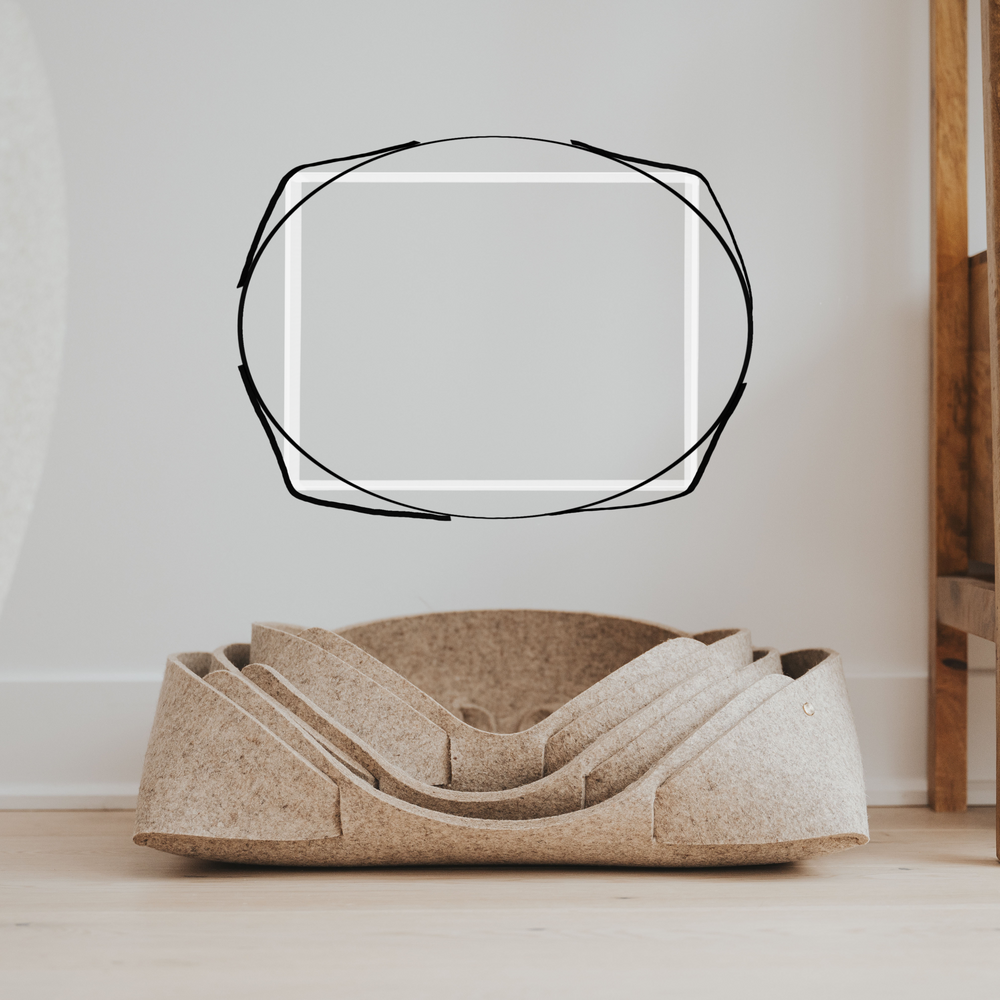
When developing the MATT™ Basket, we knew there could never be one perfect size for every cat.
Cats don't all interact with their environment in the same way.
Some naturally seek compact spaces.
Others appreciate greater freedom of movement.
That's why we developed several sizes—not simply to offer different dimensions, but to respect different resting behaviors.
For us, designing multiple sizes wasn't about creating more options.
It was about acknowledging that every cat experiences comfort differently.
What this question teaches us
Choosing the right bed isn't simply about finding one that's large enough.
It's about understanding how your cat experiences comfort.
Cats constantly tell us what they prefer.
We simply need to pay attention.
At MATT™, we believe the best-designed objects don't ask animals to adapt to them.
Instead, they adapt to the natural behaviors of those who use them.
What inspired MATT™
Our signature basket was designed around the way cats naturally occupy space.
Its gently rounded corners provide comfortable points of contact when cats curl up to sleep.
Its structure supports their natural movements without restricting them.
And its range of sizes allows each cat to find a space that reflects its own sleeping habits.
Rather than creating one universal bed, we chose to design a collection that respects the individuality of every cat.
A final thought
Cats remind us that comfort isn't measured in square inches.
It's measured by how a space makes us feel.
Good design isn't about adding more space.
It's about creating the right space.
Related Articles
- Why do cats love boxes so much?
- Why do cats sleep curled up?
- Why are cats attracted to wool?
- Why do cats knead blankets?
Related Products
About MATT™
MATT™ is a brand founded by architect Kim Landry.
Through The MATT™ Journal, we explore the relationship between natural materials, architecture, and the instinctive behaviors that inspire every object we create.
We believe the best products don't begin with a shape—they begin with a question.
Because before designing an object, we first seek to understand why it should exist.