
Reading time: 6min
Why are cats attracted to wool?
Ask almost any cat owner whether their cat is drawn to wool, and chances are the answer will be yes.
A wool sweater left on a chair.
A cozy wool blanket.
A felt basket.
More often than not, the cat will choose that spot on its own.
Why does wool seem so appealing?
There isn't a single answer. Like many feline behaviors, it's likely the result of several instinctive preferences working together.
The material itself.
Its warmth.
Its texture.
Its scent.
The way it responds beneath their paws.
Understanding these characteristics helps explain why so many cats seem naturally drawn to wool—and why we became fascinated by it when designing our first MATT™ Basket.
A natural fiber from the animal world
Unlike polyester, nylon, or many synthetic textiles, wool is a natural fiber that comes from sheep.
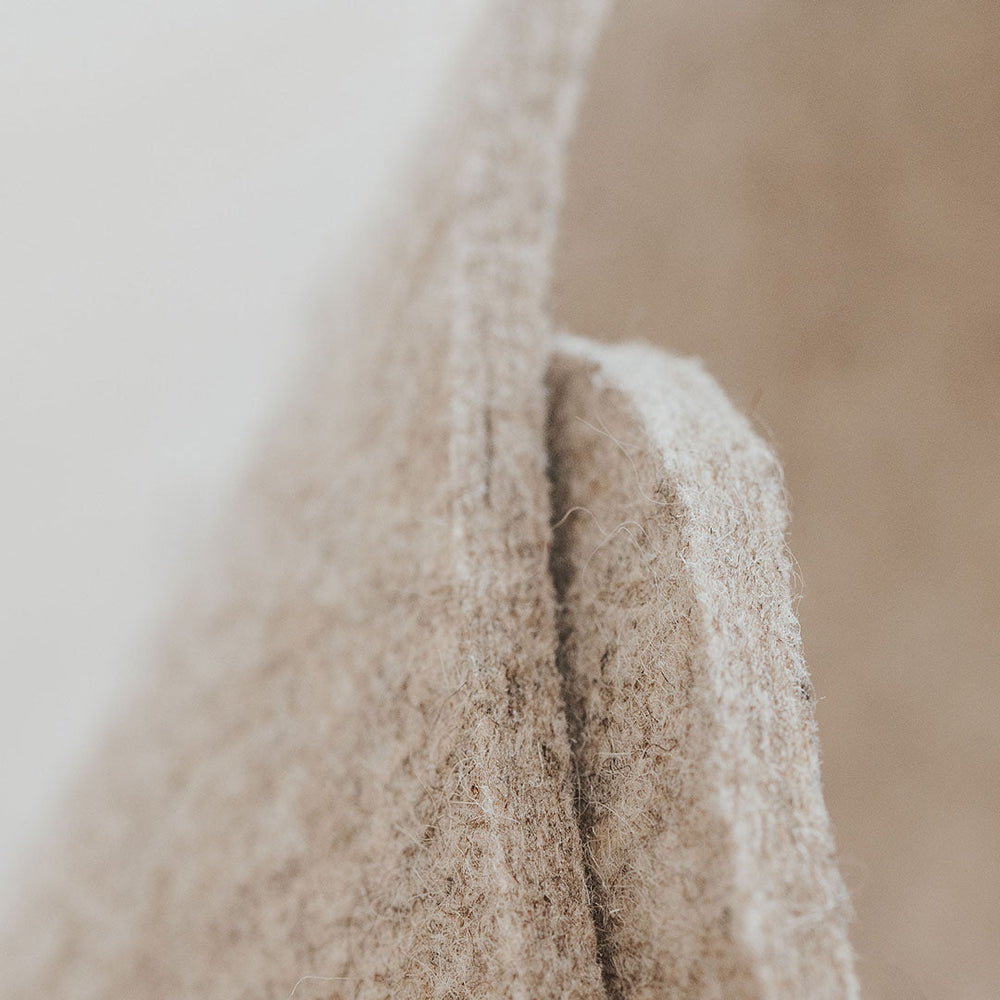
Even after it has been transformed into felt or fabric, wool retains characteristics that are unique to animal fibers. Its microscopic structure, subtle scent, and living texture are fundamentally different from those of petroleum-based materials.
Cats experience the world primarily through their senses.
Their sense of smell is estimated to be many times more sensitive than our own, and their whiskers and paw pads constantly gather tactile information about the surfaces they encounter.
Although there is no scientific evidence proving that cats prefer wool because it comes from an animal, it is reasonable to think that natural sensory cues may make it more interesting than materials that are chemically uniform and largely scent-free.
Naturally warm, without overheating
Cats instinctively seek warm places to rest.
A patch of sunlight.
A blanket.
The top of a radiator.
Or a person's lap.
This behavior isn't simply about comfort—it's also about energy conservation. Like many mammals, cats naturally reduce energy expenditure by choosing environments that help them maintain a stable body temperature.
Wool contributes to this in a unique way.
Unlike many synthetic fabrics, wool is naturally thermoregulating. Its fibers trap tiny pockets of air that act as insulation while remaining breathable, helping maintain a comfortable microclimate around the body.
Rather than simply feeling warm, wool helps prevent rapid temperature fluctuations.
That subtle difference may help explain why so many cats choose it instinctively.
A texture that responds to movement
Texture plays a much larger role than we often realize.
Cats rarely settle into a resting place immediately.
They turn.
They knead.
They adjust.
They test the surface beneath them before relaxing.
Wool responds to these movements differently than many synthetic materials.
Its fibers compress slightly, recover naturally, and create subtle tactile feedback under the paws.
This interaction makes the material feel responsive rather than static.
In many ways, the material becomes part of the resting experience itself.
Cats choose with all of their senses
Humans often choose objects based on appearance.
Cats do not.
They evaluate an environment through a combination of sensory information.
Temperature.
Texture.
Scent.
Stability.
Security.
Every surface provides information.
Every material feels different beneath their paws.
Rather than responding to aesthetics, cats respond to how a space makes them feel.
Natural wool happens to combine many of the qualities they instinctively seek in a resting place.
Observing before making assumptions
At MATT™, we believe observation should come before conclusions.
Over the years, we've watched countless cats interact with our wool felt.
Without encouragement.
Without treats.
Without training.
They simply chose it.
Of course, these observations don't replace scientific research.
Every cat has its own preferences, and no material will appeal to every animal.
But when the same behavior is observed repeatedly—by us and by many of our customers—it becomes difficult to ignore.
Sometimes, careful observation is where meaningful design begins.
What this material teaches us
Wool reminds us that a material is never defined solely by its technical properties.
It also shapes the way an object is experienced.
Its warmth.
Its texture.
Its acoustic softness.
Its natural character.
The relationship between a material and the user extends far beyond appearance.
At MATT™, choosing a material isn't simply about durability or aesthetics.
It's about designing an experience that feels intuitive—for both animals and the people who share their homes.
What inspired MATT™
When we began developing our signature basket, we weren't simply looking for a durable material.
We were looking for one that could support natural feline behaviors.
A material that felt warm.
Comforting.
Alive.
One that could respond to movement rather than resist it.
One that would age gracefully and remain beautiful over time.
That search naturally led us to wool.
Not because it was fashionable.
But because few materials combine structural performance, tactile richness, and natural warmth in quite the same way.
A final thought
Cats often remind us of something we tend to overlook.
Comfort isn't determined solely by what we see.
It's shaped by what we feel.
Sometimes, the best material isn't the one with the most technology or the most elaborate construction.
It's simply the one that feels right.
Related Articles
- Why do cats love boxes so much?
- Why do cats sleep curled up?
- Why do cats knead blankets?
- How to choose the right bed for your cat
Related Products
About MATT™
MATT™ is a brand founded by architect Kim Landry.
Through The MATT™ Journal, we explore the relationship between natural materials, architecture, and the instinctive behaviors that inspire every object we create.
We believe the best products don't begin with a shape—they begin with a question.
Because before designing an object, we first seek to understand why it should exist.