
Reading time: 8 minutes
Why does wool feel so familiar to cats?
Ask a cat owner whether their companion is drawn to wool, and there is a good chance the answer will be yes. A sweater left on a chair, a wool blanket, or a felt basket can quickly become the place a cat chooses to settle.
Why does this material seem to hold such appeal? There is no single clear answer, but several explanations help us better understand this behavior. One popular theory suggests that the scent or texture of wool, and more specifically the natural presence of lanolin in raw wool fiber, may remind cats of certain sensory signals associated with the animal world, comfort, or their earliest life experiences.
Still, it is important to remain careful. We cannot say that cats like wool because it directly reminds them of their mother’s pheromones. What makes this theory interesting, however, is that it reminds us of something essential: cats do not choose a material only with their eyes. They evaluate it through scent, touch, body memory, sensory experience, and instinct.
For a cat, a material is never just a surface. It is information.
Cats experience the world through their senses
We tend to evaluate an object by the way it looks. We notice its shape, color, style, or how well it fits into a room. Cats do not experience objects in quite the same way. They read their environment through their senses.
They smell a material, touch it with their paws, and test it before lying down. They notice how it moves, warms up, holds scent, or responds when they knead it. It is a much more physical and sensory way of interacting with an object.
For kittens, scent plays a role very early in life. From their first days, smells help them orient themselves toward their mother, find milk, and recognize a reassuring environment. The connection between scent, safety, and comfort is therefore built very early in a cat’s life.
That may be one reason why certain materials seem to speak to them more than others. They are not only comfortable. They are recognizable, interesting, and sometimes even familiar from a sensory point of view.
The role of maternal signals
Pheromones and chemical signals play an important role in several feline behaviors. They are involved in social interactions, exploration, territorial marking, and the relationship between a mother cat and her kittens.
This does not mean that wool reproduces maternal pheromones. That would be too strong, and probably inaccurate. Wool does not become a substitute for the mother. However, it does belong to the world of animal fibers. It has a structure, a texture, and sometimes a subtle scent that a cat may perceive differently from a very uniform synthetic textile.
This is where the theory becomes interesting. Wool may not directly recall one specific pheromone, but it may offer a combination of sensory signals that feel natural, alive, or familiar to some cats.
In other words, their attraction is probably not explained by one single factor. It is the combination: the subtle scent, the warmth, the texture, the density, and the way the material responds to the body.
What is lanolin?
Lanolin is a natural wax produced by sheep. It is found in raw wool and helps protect the fleece from rain, moisture, and environmental changes. You can think of it as a first layer of natural protection.
After shearing, wool is washed and transformed. A large portion of the lanolin is removed during this process in order to clean the fibers and prepare them for use. Depending on the type of wool, the manufacturing process, and the final finish, small traces may still remain.
That is why nuance matters. We cannot say that all wool products contain a significant amount of lanolin, nor that lanolin alone explains why cats are interested in wool. It is part of the story of the fiber, but it likely does not explain everything.
What it does remind us is that wool is not a neutral material. It comes from the living world. It was developed by nature to protect an animal exposed to cold, moisture, and changing temperatures. This origin gives the fiber properties that synthetic materials often try to reproduce, without always fully achieving the same result.
Why this theory remains interesting
Even if lanolin is not proof on its own, it opens an important reflection on the way cats perceive materials. A cat does not think, “this material is natural.” It feels it.
A cat may perceive its warmth, texture, subtle scent, density, and the way it reacts beneath its paws. A natural fiber like wool does not have the same presence as a very smooth, uniform, or plastic-like synthetic textile.
To us, the difference may seem subtle. For an animal that explores the world primarily through its senses, it may be much more meaningful.
That is what makes wool interesting. It does not function only as a soft surface. It offers a fuller experience: thermal, tactile, olfactory, and mechanical.
Texture, warmth, and sensory memory
Cats are not only looking for something soft. They are looking for an environment that helps them feel good. A material can be soft, but too cold. It can be warm, but too insulating. It can be thick, but unstable. It can feel comfortable to us, but uninteresting to them.
Wool has several qualities that seem to align with what many cats naturally seek. It is warm, breathable, textured, and naturally pleasant to the touch. It also has a certain elasticity and an ability to respond slightly to movement.
When a cat kneads a wool blanket or settles into a felt basket, the material does not remain perfectly rigid. It offers gentle resistance, moves slightly with the body, and then returns to place. This interaction may seem small, but it is part of the experience.
For a cat, comfort is not only about softness. It is also about how a material responds to the body.
Why our felt is safe
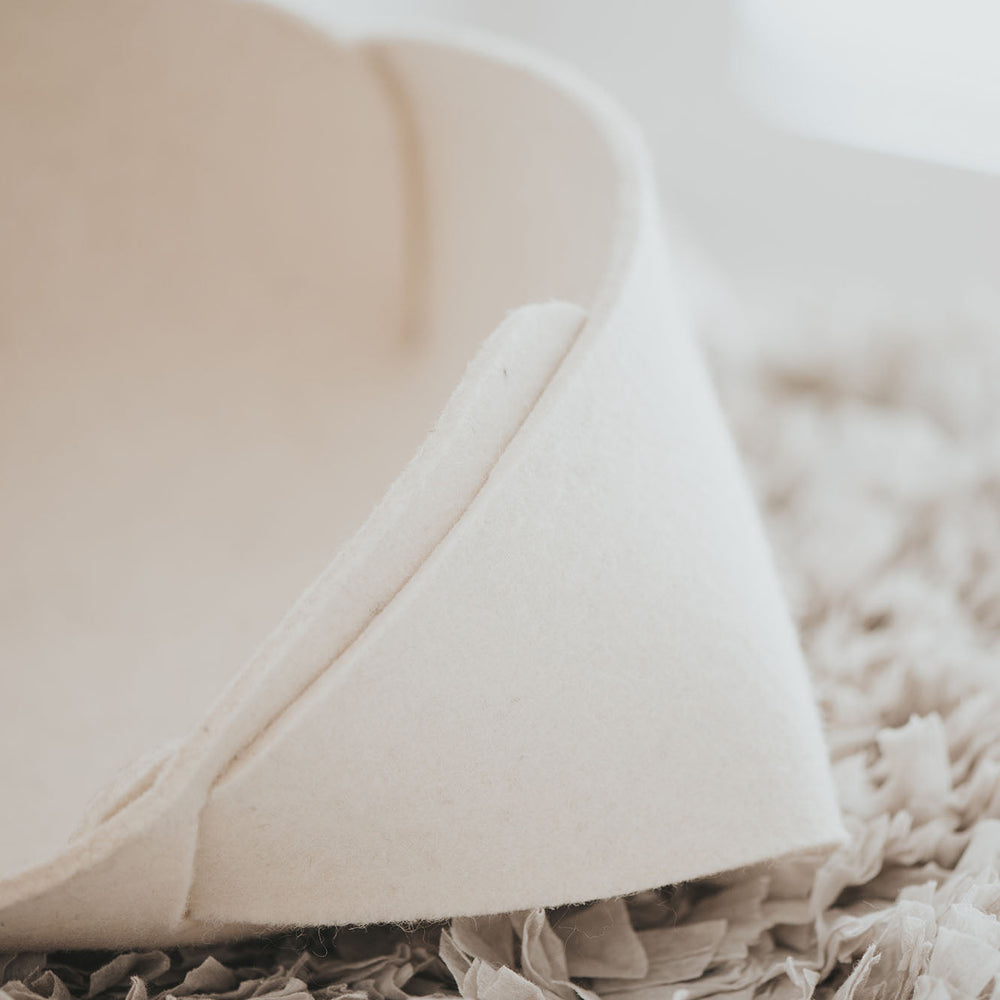
At MATT™, we use high-density natural wool felt for our pet baskets. It is not a thin decorative felt, a fragile textile, or a padded cushion with a cover that could tear and expose loose filling.
Our felt is a full, dense, and stable material made through a felting process that compacts and interlocks wool fibers. Unlike woven fabric, it does not rely on threads that can pull, unravel, or quickly create an opening. This structure matters, especially for cats.
Cats may naturally knead the material, roll on it, rub against it, or even try to tuck themselves slightly underneath it. With normal use, claws may leave small surface marks over time, as they can with any natural material used daily, but they should not easily create holes in the felt.
This is one of the reasons we chose this material. It is strong enough to support natural feline behaviors while remaining soft, warm, and pleasant to the touch.
As with any product designed for animals, we recommend supervising use if your pet tends to chew, destroy, or ingest accessories. The MATT™ Basket is designed as a durable resting space, not as a chew toy.
Wool and odors: a common misconception
Many people associate natural materials with something that is harder to care for. Yet wool behaves differently from many synthetic fibers.
Wool is naturally hygroscopic. This means it can absorb part of the water vapor present in the air and release it gradually depending on surrounding conditions. This ability to manage moisture helps explain why wool has long been used in technical clothing, blankets, and high-quality textiles.
Persistent odors are often linked to moisture and microbial activity. Wool should not be presented as an antibacterial material in the medical sense, but its ability to manage moisture differently from many synthetic fibers can help limit the conditions that encourage unpleasant odors.
This does not replace proper care. A wool product used every day should still be cleaned when needed. But it helps explain why this material has been used for so long in objects related to rest, comfort, and everyday life.
Observing before assuming
At MATT™, we like to observe before making claims. Over time, we have seen many cats settle spontaneously on our wool felt. Without treats. Without training. Without being pushed toward the object.
They simply choose it on their own.
This observation is not scientific proof, but when it repeats itself in our own experience and with our customers, it becomes an interesting clue. Cats seem to recognize something in the material: warmth, texture, density, sensation, or perhaps even a kind of sensory familiarity that we do not perceive in the same way.
This is often where design begins at MATT™. Not with an abstract idea, but with a simple observation from everyday life.
What this material teaches us
Wool reminds us that a material is never defined only by its composition. Its value also comes from how it behaves.
How does it respond to touch? How does it manage warmth? How does it age? How does it interact with the body? How is it perceived by an animal that explores the world mainly through its senses?
This is the way we like to look at materials.
A material is not only chosen for what it is. It is chosen for what it allows us to experience.
What inspired MATT™
When we began designing the MATT™ Basket, we were not simply looking for a natural material. We were looking for a material capable of supporting instinctive animal behaviors.
A material cats could knead. A material they could roll on. A material stable enough to hold its shape, yet responsive enough to react to their movements. A material that felt durable, reassuring, and naturally integrated into the home.
That reflection led us to high-density wool felt.
Not because it is trendy, but because it brings together qualities that are rarely found in a single material: warmth, structure, durability, breathability, and sensory richness.
A final thought
Cats remind us that comfort is not only about softness. It comes from a combination of signals: warmth, texture, scent, stability, and the way a material responds to the body.
That may be what makes wool so particular. It does not simply feel comfortable. It communicates something.
And cats seem to understand it very well.
Related articles
- Why are cats so attracted to wool?
- Why do cats knead blankets?
- Why do cats love boxes?
- Why has wool stood the test of time?
- Understanding industrial wool felt
Related products
- MATT™ pet basket
- Minimalist Cushion
- Premium Cushion
- Wool felt scratching mat
About MATT™
MATT™ is a brand founded by architect Kim Landry.
Through The MATT™ Journal, we explore animal behaviors, natural materials, and thoughtful design to better understand what inspires each of our objects.
We believe the best products always begin with a deeper understanding of those who use them.