
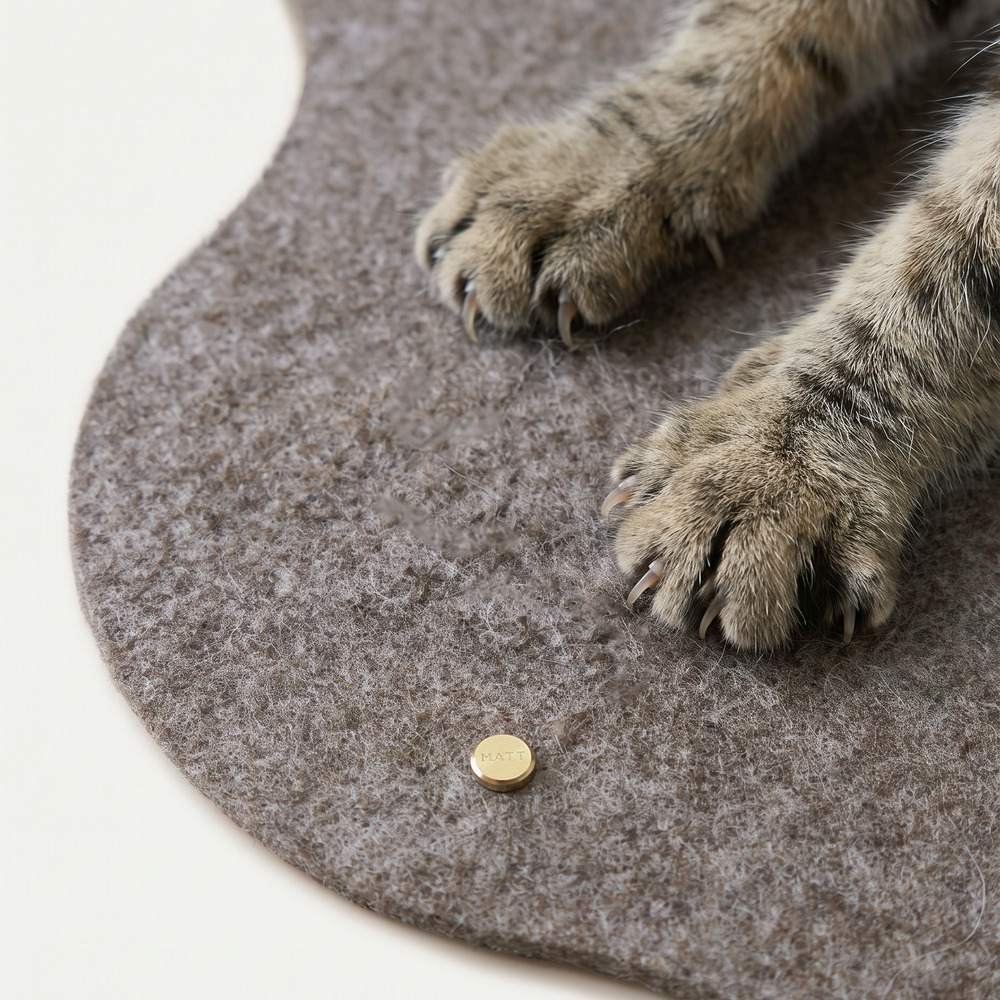
Is felt a good material for cats to scratch?
Scratching is a natural and essential behaviour for cats. It allows them to stretch, maintain their claws and interact with their environment.
Cardboard, sisal and certain textiles are commonly used for cat scratchers, but wool felt offers a very different experience.
So, is felt a good material for cats to scratch?
The answer is yes — as long as the right type of felt is used. Its composition, thickness and, most importantly, its density directly influence its resistance and how it performs over time.
Why do cats like scratching felt?
Cats naturally seek out surfaces that provide enough resistance for their claws to properly engage.
Unlike a very rigid surface, felt has a certain degree of flexibility. When a cat digs its claws into it, the fibres and the material respond slightly to the movement.
This tactile resistance can make felt particularly interesting for cats that enjoy horizontal scratching.
The natural character of wool also plays an interesting role. Its texture, scent and the way its fibres respond under the claws can naturally spark a cat’s curiosity. This attraction to the material may make the transition to a new scratching surface feel more intuitive and encourage use from the very first interactions.
As with any scratching surface, however, every cat has its own preferences.
Not all felt is the same
This is probably the most important thing to understand when choosing a felt cat scratcher or scratching mat.
The thin felt commonly found in craft stores is very different from dense wool felt designed for demanding applications.
A surface intended for scratching needs enough structure to withstand the repeated action of a cat’s claws.
At MATT™, our scratching mat is made from industrial-grade wool felt approximately 5 mm thick, or close to ¼ inch. Its high density gives it significantly more resistance than lightweight felt while maintaining the flexibility that makes this material so interesting.
Its tensile strength is also very high. This mechanical property allows the felt to withstand repeated stress without quickly tearing or breaking apart under the action of the claws.
This is an important difference compared with traditional cardboard scratchers, where layers can gradually be pulled apart and create a significant amount of small debris.
Dense felt will naturally show signs of use, and some surface fibres may lift over time, but the material retains its structure and integrity much more effectively.
For a product intentionally exposed to a cat’s claws, this combination of density, tensile strength and flexibility is essential.
Wool felt vs. synthetic felt for a cat scratcher
Felt can be made from natural wool, synthetic fibres or a blend of fibres.
For our pet products, we chose a felt with a high wool content rather than conventional synthetic felt.
Wool is naturally breathable, moisture resistant and resilient. Its fibrous structure allows the material to compress and respond to movement rather than behaving like a simple sheet of fabric.
For a scratching mat, this creates a surface that remains structured while still providing some flexibility beneath the claws.
This choice also reflects our broader approach at MATT™: prioritizing natural materials whenever they can effectively serve the function of the product.
Does a felt cat scratching mat shed?
Some movement of the surface fibres is completely normal when a material is repeatedly exposed to a cat’s claws.
The amount of fibre that comes loose, however, depends greatly on the quality and density of the felt.
Low-density felt can break down quickly, while dense industrial felt maintains its structure much more effectively.
Over time, scratching will naturally leave marks and some fibres may lift. Unlike a material that comes apart in layers, however, dense industrial felt continues to maintain its overall integrity.
A lint brush, cashmere comb or vacuum can occasionally be used to refresh the surface and remove loose fibres.
Signs of use are simply part of the life of the product: a scratching mat is designed to be used, not to remain perfectly untouched.
How do you clean a wool felt cat scratching mat?
Wool felt is relatively simple to maintain.
For regular care, we recommend using a lint brush or vacuum to remove hair and loose fibres.
For small stains, the felt can be spot cleaned using cold water and a mild soap, then left to air dry.
Wool also responds well to steam. A steam iron can therefore help flatten the felt or restore its shape when needed.
The main goal is to avoid completely saturating the material with water.
Are horizontal scratchers good for cats?
Yes. Many cats enjoy scratching both vertical and horizontal surfaces.
A horizontal scratching mat allows a cat to stretch forward while engaging its claws with the surface. It can therefore complement a vertical scratching post rather than necessarily replacing it.
Some cats have a strong preference for one orientation, while others use both.
One of the advantages of a flat scratching mat is its versatility: it can easily be moved throughout the home and placed directly where your cat naturally tends to scratch.
It can also be placed on a sofa or another more delicate surface you want to protect. Thanks to the thickness and density of the felt, the mat creates a protective layer between your cat’s claws and the surface underneath.
This can be particularly useful when a cat has already developed the habit of scratching a specific area. Rather than trying only to change the behaviour, you can offer an appropriate scratching surface directly where the behaviour already happens while helping protect your furniture.
Can you use felt to make your own cat scratcher?
Yes, but once again, the type of felt you choose matters greatly.
For a felt cat scratcher, it is best to choose a material that is:
- thick enough to withstand repeated scratching;
- very dense;
- made with good tensile strength;
- composed of fibres that do not easily break apart;
- large enough for your cat to comfortably stretch across.
Thin craft felt is generally not designed for this type of mechanical wear.
Dense wool felt behaves very differently.
How long does a felt cat scratching mat last?
There is no universal lifespan for a scratching surface.
It depends on the cat, how frequently it is used, the strength of the scratching behaviour and the density of the material.
The surface will naturally evolve over time. Scratch marks and some movement of the fibres are to be expected.
The advantage of a dense and resistant felt is that the material can continue to perform its function even as the surface gradually develops visible signs of use.
Its structure remains in place, allowing the mat to continue providing resistance beneath the claws rather than simply breaking apart over time.
How did the MATT™ cat scratching mat come to life?
The idea for the scratching mat came directly from the experience of our customers.
Since launching our wool felt pet products, we have received many comments from customers telling us just how drawn their cats seemed to be to the material.
Several told us that their cats loved kneading the felt with their paws, lying on it and, most of all, scratching it.
Seeing this reaction again and again made us look at the material differently. Its texture, density and the resistance it provides beneath the claws naturally made it an interesting surface for this behaviour.
That is how the idea for the MATT™ Cat Scratching Mat was born: by transforming a spontaneous interaction between cats and the material into an object specifically designed for that purpose.
We kept the simplicity of the felt at the heart of the design: a dense, flexible and movable surface that can be placed directly where your cat likes to scratch — on the floor, on a sofa or over another surface you want to protect.
The result is a scratcher that grew first and foremost from observing cats’ behaviour and their relationship with the material.
So, is felt a good material for cats to scratch?
Yes. Dense wool felt can make an excellent scratching surface for cats, particularly for horizontal scratching.
The important thing to understand is that the word “felt” describes a very broad range of materials.
Thickness, density, fibre composition and mechanical resistance all influence how the material will respond to scratching.
That is precisely what makes wool felt so interesting to us: it brings together function, resistance, simplicity and natural material while integrating harmoniously into our living spaces.
Discover the MATT™ Wool Felt Cat Scratching Mat
Frequently asked questions
Is felt good for cats to scratch?
Yes. Felt with sufficient density provides resistance for the claws while maintaining a certain degree of flexibility. Material quality matters, however: thin craft felt will not perform the same way as industrial-grade wool felt.
Why are cats attracted to wool felt?
Wool is a natural fibre whose texture, scent and structure can naturally spark a cat’s curiosity. This affinity with the material may make adapting to a scratching surface easier and encourage use from the first interactions. Preferences will, of course, vary from one cat to another.
What type of felt is best for a cat scratcher?
Look for a felt that is thick, dense and resistant enough to withstand repeated clawing. Industrial-grade wool felt will generally be much better suited to this type of use than lightweight craft felt.
Is a felt cat scratcher more durable than a cardboard scratcher?
Dense industrial felt has a very different structure from cardboard. Its high tensile strength helps it maintain its integrity under repeated stress. The surface may develop marks and some fibres may lift, but it does not come apart in layers the way a traditional cardboard scratcher can.
Can you place a felt cat scratching mat on a sofa?
Yes. A dense felt scratching mat can be placed directly on a sofa or another surface you want to protect. Its thickness creates a protective layer between your cat’s claws and the furniture while providing an appropriate scratching surface exactly where your cat may already tend to scratch.
Can a cat damage wool felt?
Yes. A scratching mat is designed to be used, and its surface will naturally evolve over time. Claws may create marks and move some of the surface fibres, which is part of the product’s normal wear.
How do you care for a felt cat scratching mat?
A lint brush, cashmere comb or vacuum is generally enough for regular maintenance. Small stains can be spot cleaned with cold water and a mild soap, then left to air dry.