
Reading time: 6min
Why do cats love sleeping in the sun?
Spend a few days observing a cat, and you'll quickly notice an interesting pattern.
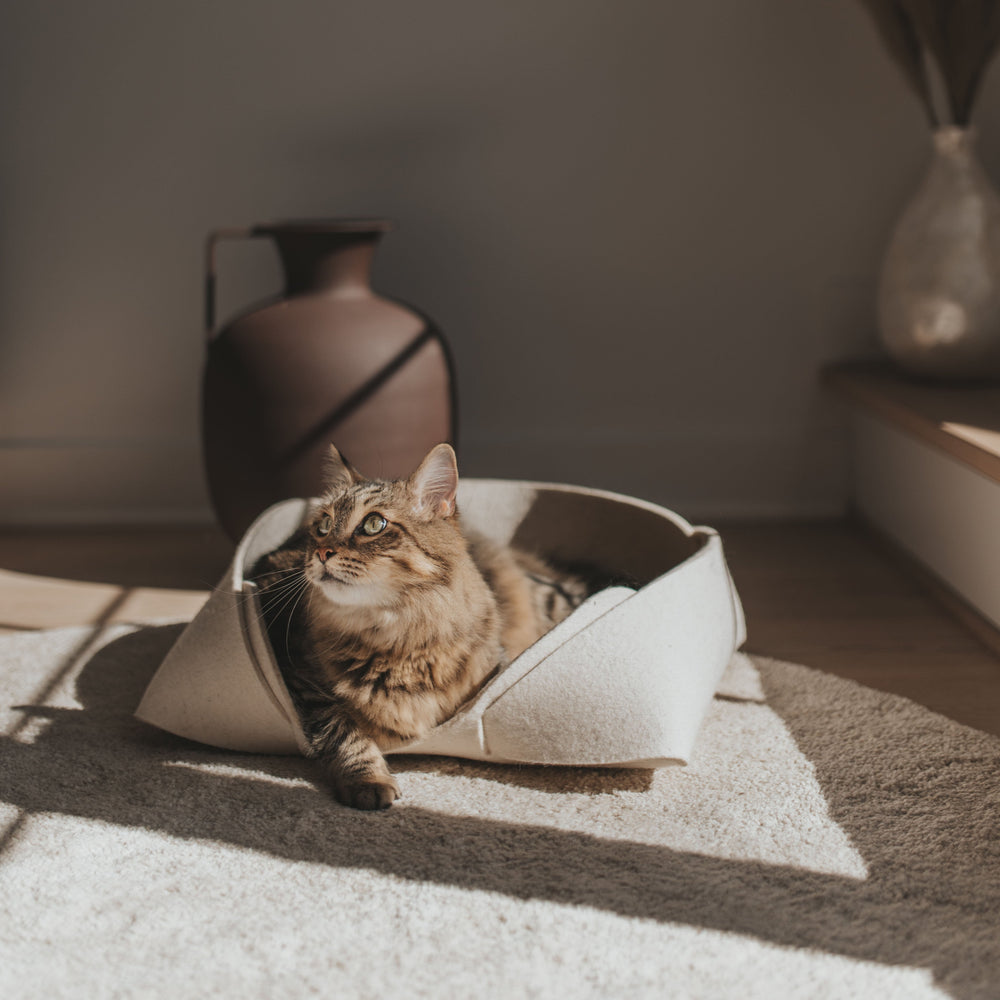
As the day goes on, your cat seems to follow the sunlight throughout the house.
In the morning, it's stretched out on the floor beside a window.
A few hours later, it's moved to the sofa.
By late afternoon, it's peacefully sleeping on the bed—exactly where the sunbeam has shifted.
At first glance, the answer seems obvious.
Cats simply like being warm.
But there's more to this behavior than comfort alone.
It reflects millions of years of evolution, remarkable energy efficiency, and the way cats naturally regulate their bodies.
Cats naturally seek warmth
Cats have a slightly higher body temperature than humans, typically ranging between 38°C and 39°C (100.4–102.5°F).
Maintaining that temperature requires energy.
Like all mammals, cats are constantly balancing the energy they consume with the energy they expend.
Choosing a warm resting place allows them to conserve part of that energy rather than using it to maintain body heat.
From an evolutionary perspective, this makes perfect sense.
Every bit of energy saved while resting is energy available for hunting, exploring, or responding to potential threats.
Even though house cats no longer hunt to survive, their bodies continue to operate according to many of the same biological principles.
Sunlight creates a naturally comfortable microclimate
A patch of sunlight offers more than warmth.
It creates what scientists sometimes refer to as a microclimate—a small area where temperature differs from the surrounding environment.
Rather than warming the entire room, the sun warms the surface itself.
A blanket.
A windowsill.
A wooden floor.
The top of a sofa.
Cats instinctively seek these localized pockets of warmth because they provide comfort without requiring additional energy from the body.
In many ways, they're simply taking advantage of one of nature's most efficient heating systems.
An instinct inherited from their ancestors
Long before cats shared our homes, their wild ancestors also sought sunny resting places.
After periods of hunting or exploration, warmth helped them recover while conserving valuable energy.
The behavior wasn't simply pleasant.
It was efficient.
Today's house cats have inherited many of these same instincts.
The environment has changed.
Their biology has not.
That's why even indoor cats often move from one sunny spot to another as daylight shifts throughout the day.
Warmth encourages relaxation
Cats naturally alternate between short periods of activity and long periods of rest.
Unlike humans, who often consolidate most of their sleep into one long period, cats spread their rest throughout the day.
Warm environments appear to support this natural rhythm.
Heat helps muscles relax.
The body requires less effort to maintain temperature.
The environment feels safe and predictable.
It's no surprise that many cats begin stretching, purring, kneading, or falling into deep sleep shortly after settling into a sunbeam.
Do all cats enjoy the sun?
Most do—but not all in the same way.
Cats constantly adjust their behavior according to their environment.
During cooler months, they often seek sunny locations more frequently.
On particularly hot days, however, many will choose shaded floors, tile, or cooler rooms instead.
This flexibility illustrates something fascinating.
Cats aren't simply searching for heat.
They're seeking thermal comfort.
In other words, they instinctively adjust their resting place to maintain a comfortable body temperature rather than maximizing warmth at all costs.
A comfortable resting place is about more than sunlight
Sunlight is only one piece of the puzzle.
When choosing where to rest, cats appear to evaluate several environmental factors at once.
Temperature.
Comfort.
Security.
Visibility.
Noise.
Surface texture.
Rather than choosing a location for a single reason, they seem to balance all of these elements simultaneously.
This may explain why one particular spot in the house becomes a favorite while another, equally sunny location remains untouched.
The best resting place isn't defined by one characteristic.
It's the combination that matters.
What this behavior teaches us
Watching a cat follow the sunlight reminds us that comfort doesn't depend on an object alone.
It also depends on the environment surrounding it.
Light.
Temperature.
Acoustics.
Security.
Together, these elements shape the experience of rest.
As designers, it's an important reminder.
Sometimes improving comfort isn't about designing a different object.
It's about understanding the environment in which that object will be used.
What inspired MATT™
At MATT™, we've always believed that a great resting space is more than a basket or a cushion.
Its location matters just as much.
Placed near a quiet window, beside a favorite chair, or wherever gentle morning light enters the room, our baskets often become one of a cat's preferred places to rest.
Material also plays an important role.
That's why we chose natural wool.
Unlike many synthetic materials, wool is naturally thermoregulating. Rather than simply trapping heat, its fibers help create a comfortable microclimate by insulating while remaining breathable. This allows the material to feel warm on cool days without becoming overly insulating when temperatures rise.
Good design doesn't compete with instinct.
It works alongside it.
A final thought
Cats remind us that comfort isn't something we create.
It's something we understand.
Sometimes the best resting place isn't defined by the bed itself.
It's defined by where the morning sun happens to fall.
Related Articles
- Why do cats love boxes so much?
- Why do cats sleep curled up?
- Why are cats attracted to wool?
- Why do cats love high places?
Related Products
About MATT™
MATT™ is a brand founded by architect Kim Landry.
Through The MATT™ Journal, we explore animal behavior, natural materials, and thoughtful design to better understand the relationship between instinct and everyday objects.
We believe the best products begin with a deeper understanding of those who use them—not with assumptions, but with careful observation.