
Reading time: 5min
Why do dogs turn in circles before lying down?
Almost every dog owner has witnessed this familiar ritual.
Before settling down, a dog will often turn once, twice, or sometimes even three times before finally lying down.
To us, it may seem like an amusing habit.
To a dog, it's something much more meaningful.
This small ritual has survived thousands of years of evolution, reminding us that even though our dogs now sleep on comfortable beds inside our homes, many of their instincts remain remarkably unchanged.
Understanding this behavior helps us see that a resting place isn't simply where a dog sleeps—it's a space where instinct, comfort, and environment all come together.
An instinct inherited from their wild ancestors
Long before dogs shared our homes, their ancestors slept outdoors.
Before lying down, they would often circle to flatten tall grass, leaves, or snow, creating a more comfortable and stable surface.
This movement likely served more than one purpose.
It helped prepare the ground.
It may have discouraged insects or other small animals.
It also allowed them to briefly assess their surroundings before becoming vulnerable during sleep.
From a behavioral perspective, this simple ritual increased both comfort and security.
Although modern dogs no longer need to prepare the forest floor, the behavioral sequence itself has remained.
Like many instinctive behaviors, the original purpose has largely disappeared, while the ritual continues.
More than a habit—it's a transition
Circling isn't simply an old instinct.
For many dogs, it also appears to function as a transition between activity and rest.
Humans have similar rituals.
We fluff a pillow.
Pull up a blanket.
Adjust the room temperature.
Read a few pages before going to sleep.
None of these actions are strictly necessary.
Yet they help signal to the brain that it's time to slow down.
Dogs may experience something similar.
The act of circling appears to be part of the process of settling, both physically and mentally.
Every dog has its own routine
Not every dog circles the same number of times.
Some turn only once.
Others continue circling until everything feels just right.
Age.
Breed.
Personality.
Joint mobility.
Even the surface they're lying on can influence this behavior.
That's why there isn't a "normal" number of circles.
The important observation isn't how many times a dog turns.
It's that many dogs have developed their own consistent resting routine.
Dogs seek more than a soft surface
When choosing a bed, many people focus primarily on cushioning.
Dogs, however, seem to evaluate a resting place differently.
Comfort certainly matters.
But so do stability, predictability, and a sense of security.
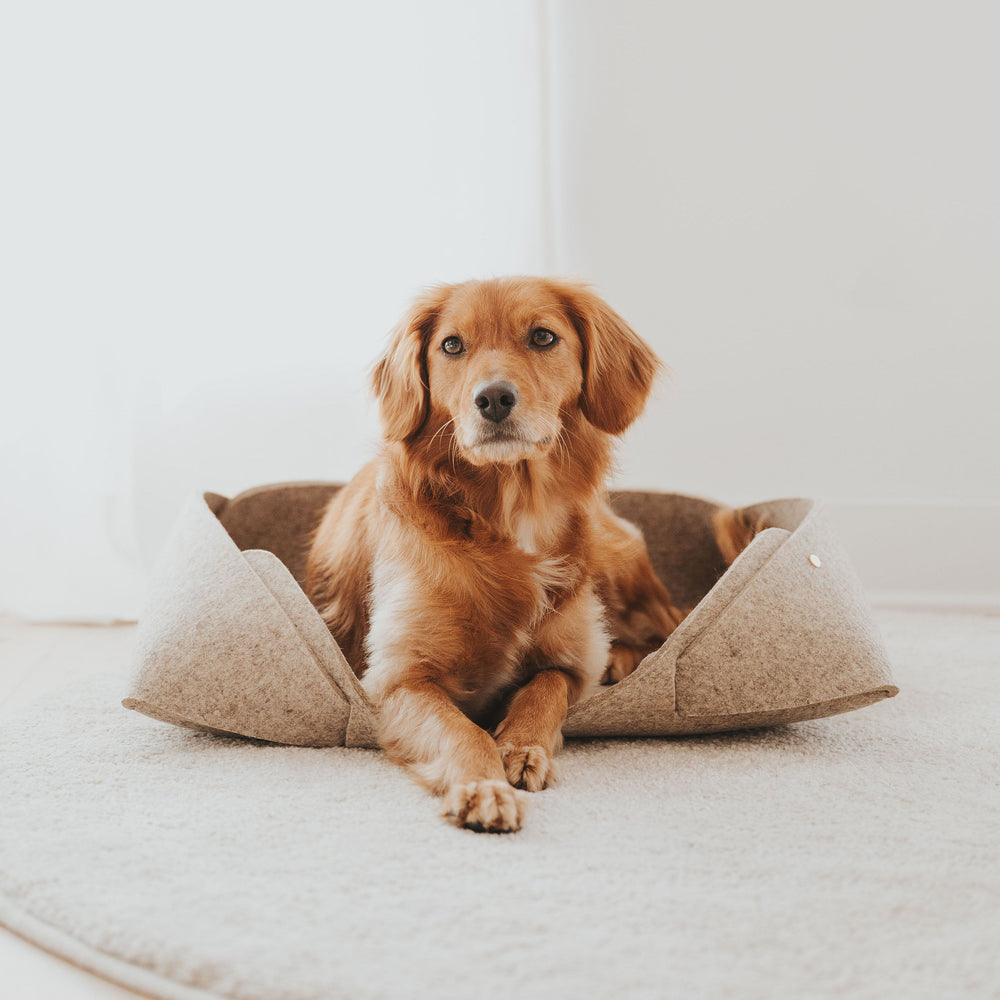
Many dogs naturally gravitate toward beds with supportive edges, corners they can lean against, or spaces that feel gently defined.
Just as cats often prefer clearly bounded resting places, many dogs also appear to appreciate subtle physical structure around them.
Comfort isn't determined by softness alone.
It's shaped by how the entire environment feels.
Behavior tells us more than measurements
When selecting a bed, weight charts provide a useful starting point.
But they rarely tell the whole story.
Some dogs stretch out completely.
Others curl into a tight ball.
Some rest with their head elevated.
Others always sleep pressed against a bolster or cushion.
These behaviors reveal far more than measurements alone.
A dog's sleeping habits often matter more than its size.
The more carefully we observe, the more naturally we can choose an environment that supports those habits instead of asking the dog to adapt.
What this behavior teaches us
Watching a dog turn in circles reminds us that instinct doesn't disappear simply because circumstances change.
Our homes may be different from the environments where these behaviors first evolved.
The behaviors themselves often remain remarkably similar.
Rather than trying to change them, good design should acknowledge them.
The best resting spaces don't simply provide comfort.
They respect the rituals that make animals feel comfortable in the first place.
What inspired MATT™
At MATT™, we believe every object begins with careful observation.
A dog's circling ritual is a reminder that resting isn't simply about lying down.
It's a sequence of behaviors.
Preparing.
Exploring.
Settling.
Relaxing.
Our baskets are designed with this philosophy in mind.
Stable construction.
Natural materials.
Simple forms that support instinctive behaviors rather than interrupt them.
Because we believe the best design rarely teaches animals new habits.
Instead, it quietly supports the ones they already have.
A final thought
Animals rarely overthink comfort.
They simply respond to environments that feel right.
Perhaps that's one of the most valuable lessons they can teach us.
Good design doesn't begin by asking how an object should look.
It begins by asking how it should be experienced.
Related Articles
- How to choose the right bed size for your dog
- Why do dogs love raised edges on their beds?
- Why do dogs carry toys to their bed?
- Why do dogs like sleeping near their humans?
Related Products
About MATT™
MATT™ is a brand founded by architect Kim Landry.
Through The MATT™ Journal, we explore animal behavior, natural materials, and thoughtful design to better understand the relationship between instinct and everyday objects.
We believe the best products begin with a deeper understanding of those who use them—not with assumptions, but with careful observation.