
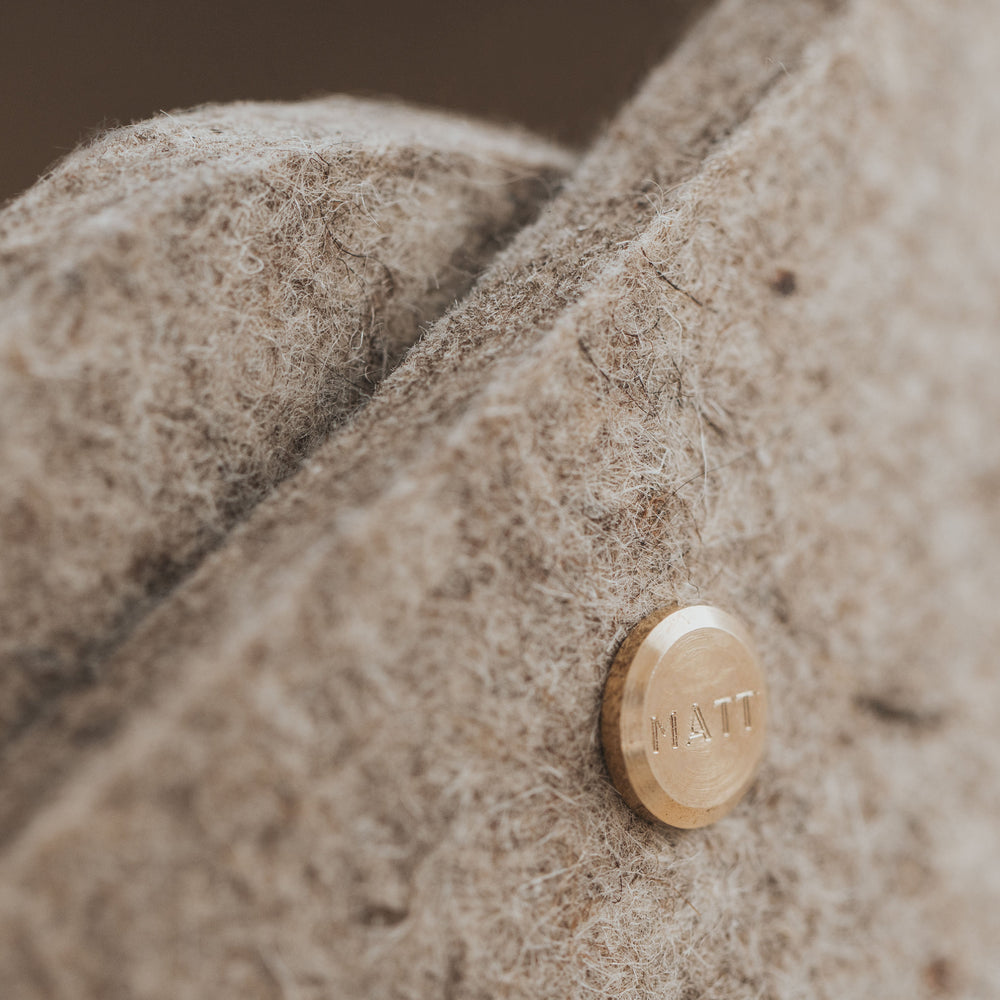
Wool felt vs synthetic felt: what’s the difference?
Reading time: 7 minutes
At first glance, two sheets of felt can look almost identical. Same thickness, same color, same shape. Yet wool felt and synthetic felt can behave very differently.
The difference goes far beyond composition. It can affect strength, moisture management, response to heat, natural odor resistance, texture, and the way the material ages.
At MATT™, we choose natural wool felt for these very specific characteristics. Its strength, resilience, natural moisture management, and durability make it particularly well suited to objects used every day, whether it is a pet basket, a desk accessory, or a storage object.
The choice is therefore not simply about wool being natural. It is about what this fiber is capable of doing.
So, what is the real difference between wool felt and synthetic felt?
In short: wool felt vs synthetic felt
Wool felt is made primarily or entirely from natural wool fibers. The structure of the fiber itself gives it several interesting properties: it can manage some of the water vapor present in its environment, contribute to thermal comfort, offer good resilience, and tend to stay fresher for longer between cleanings.
Synthetic felt, on the other hand, is generally made from fibers such as polyester. Depending on the intended use, these fibers can be bonded mechanically, thermally, or through other industrial processes to achieve specific characteristics.
Neither is automatically better than the other.
The more important question is:
Which material best serves the function of the object?
First, what is felt?
Felt is different from traditional woven fabric.
A woven textile is constructed from threads that cross over one another in a defined structure. In felt, the fibers themselves are interlocked to create the material, without first having to form threads and then weave them together.
This is one of the most interesting characteristics of felt.
Fabric is built from threads. Felt is built from fibers.
In the case of wool, the natural characteristics of the fiber allow the fibers to interlock and gradually bind together during the felting process.
Synthetic felts can also be made from interlocked fibers, but their bonding generally relies on mechanical, thermal, or chemical processes suited to the material being used.
This difference in construction helps explain why felt does not behave exactly like woven fabric when it is cut, folded, or used as a structural material.
It is also what allows certain felts to be cut with very clean edges without requiring stitching along every side.
The first difference is in the fiber
Wool is a natural animal fiber. Its structure is far more complex than it appears to the naked eye. Each fiber has a natural crimp and multiple layers that influence its elasticity, resilience, and response to moisture.
Synthetic fibers such as polyester are made from polymers. Their composition and manufacturing process can be adjusted to achieve very specific performance characteristics.
This is a fundamental difference.
In one case, we are working with a fiber whose characteristics already exist naturally.
In the other, we are working with an industrially manufactured fiber developed according to the performance required.
That difference in origin influences how the two materials behave in everyday use.
Wool naturally interacts with moisture
This is one of wool’s most interesting characteristics, particularly for objects used in the home and by pets.
Wool is hygroscopic. This simply means that it can absorb some of the water vapor present in its environment and gradually release it as conditions change.
Moisture is therefore not limited to the surface of the material. Some of it can be temporarily absorbed within the structure of the fiber itself.
Synthetic fibers such as polyester behave differently and generally absorb much less moisture within their structure.
This does not mean wool is waterproof. It is not.
It simply means that it interacts with its environment differently.
In an object used every day, this ability can contribute to comfort and influence how the material behaves between cleanings.
What about odors?
This is another particularly interesting difference between wool and many synthetic fibers.
Wool is naturally known for its odor resistance. Its ability to manage moisture, combined with the complex structure of its fibers, helps limit the rapid development of noticeable odors within the material.
In practical terms, this means that a wool object can often stay fresher for longer between cleanings, particularly when it is regularly maintained by removing pet hair, dust, and small amounts of surface dirt.
This does not, of course, make wool self-cleaning. A pet bed or any object used every day still needs to be maintained and cleaned when soiled.
The difference lies primarily in how it is cared for: light, targeted maintenance can often be enough between deeper cleanings.
For a pet basket, for example, hair can be removed with a vacuum, lint roller, or cashmere brush, while small stains can be treated locally.
A material that responds differently to temperature
Wool is often associated with warmth, but it does not generate heat itself.
Instead, the structure of its fibers allows small pockets of air to become trapped, slowing heat transfer and helping create a more stable thermal environment.
This property is especially interesting for objects that regularly come into contact with the body, whether a textile, a work surface, or a resting space for an animal.
Wool also responds differently from many synthetic fibers when exposed to high temperatures. It does not melt in the same way certain thermoplastic fibers, such as polyester, can.
This does not mean that a wool product should be exposed to an open flame or excessive heat.
It simply shows that two materials that may look similar can behave very differently once their actual properties are considered.
A difference you can feel
There is also a much simpler difference to notice: touch.
Wool has a naturally warm and tactile texture. Depending on the type of wool, fiber diameter, density, and thickness of the felt, it can range from very soft and refined to much firmer and more structured.
Merino wool, for example, is made from particularly fine fibers and therefore offers a softer feel. Other types of wool can be used to create denser felts that are better suited to applications requiring greater structure or strength.
This is why it would be misleading to talk about “wool felt” as though it were a single material.
A merino wool felt used for a home accessory and a high-density industrial wool felt used for a pet basket can behave very differently, even though both belong to the same family of materials.
Natural does not mean fragile
Natural materials are sometimes associated with delicacy, while synthetic materials are assumed to be automatically stronger.
The reality is much more nuanced.
The performance of a felt depends not only on the fiber itself, but also on its density, thickness, composition, and manufacturing process.
A high-density industrial wool felt can be extremely robust. By contrast, a lightweight synthetic craft felt is obviously not designed to meet the same demands.
Two sheets of felt can even have exactly the same thickness and behave completely differently.
Thickness tells only part of the story. Density and material structure are just as important.
This is especially true when felt is not simply used as a covering but becomes a structural component of the object itself.
Resilience: an important property of wool
Wool also has interesting natural resilience.
Its fibers tend to recover their shape after certain types of compression or deformation, helping quality felt maintain its structure over time.
This property becomes particularly important when felt is used to create an object rather than simply cover a surface.
In a MATT™ Basket, for example, the felt needs to be flexible enough to fold and transform, while remaining stable enough to hold its shape once assembled.
This balance between flexibility and structure is precisely one of the reasons wool interests us.
Which material ages better?
There is no universal answer.
A high-quality synthetic felt developed for a technical application can have a very long lifespan. Conversely, a wool felt that is poorly suited to its intended function can wear prematurely.
But the two materials do not necessarily age in the same way.
Over time, wool may develop a few visible fibers or a slight fuzz on its surface. It can also gradually show signs of everyday use. This is a normal characteristic of a material made from natural fibers and can generally be maintained with an appropriate brush.
Its resilience can also help correct certain deformations and, depending on the product, steam can help the material recover its shape.
This is an important distinction in the way we think about durability.
A durable material is not necessarily one that remains perfectly unchanged forever.
It is a material that can age, be maintained, and continue to perform its function.
So why choose natural wool felt?
For MATT™ objects, we favor wool felt because it brings together several properties that directly support their function: strength, resilience, natural moisture management, odor resistance, an interesting response to temperature changes, and the ability to age well.
Its tactile quality and presence within a space then complement these technical properties.
There is also an important difference in the origin of the material.
Wool is a renewable fiber naturally produced by sheep, while conventional polyester is a synthetic fiber made from fossil-based raw materials.
This does not mean that a product made from wool is automatically sustainable in every respect. The origin of the material, the way it is processed, the quality of manufacturing, the lifespan of the product, and its ability to be maintained all matter.
But when a natural material already performs effectively for the properties an object requires, it becomes a particularly compelling choice for us.
Why MATT™ uses different wool felts
Not all of our products have the same requirements. We therefore select the felt according to the intended use of each object.
For our Pet Collection, we use a high-density natural wool felt made from at least 85% natural wool, complemented by recycled fibers. It was selected for its structure, strength, resilience, and ability to withstand everyday use.
A pet basket needs to support the animal’s weight, movement, claws, repeated handling, and cycles of assembly and disassembly. The felt therefore needs to be flexible enough to fold and travel flat, while remaining dense and strong enough to become a stable structure once the basket is assembled.
For our Home Collection, we use 100% natural merino wool felt. The requirements are different: we look for a softer, more refined feel, precise cutting, good structure, and a naturally warm presence within the space.
Both materials are wool felt, but their characteristics respond to different functions.
This is precisely what guides our approach to design: first understanding what the object requires from its material, then choosing the felt whose properties best serve that use.
A natural material that can also be industrial
The difference between wool felt and synthetic felt becomes particularly interesting when we look at what the material is actually capable of doing.
Wool felt is not limited to decorative or textile applications. Depending on its density, composition, and manufacturing process, it can become a high-performance industrial material, used where strength, stability, resilience, and the ability to withstand mechanical stress are important.
The high-density wool felt used for our pet baskets meets SAE specifications, a classification used for industrial felts. Its technical data indicates a minimum tensile strength of 400 psi, along with excellent abrasion resistance and 99% recovery following controlled compression.
These are precisely the characteristics that matter to us at MATT™. In our baskets, felt is not simply a covering or finish: the material becomes the structure of the object itself. It needs to be folded, handled, support the animal’s weight and movement, and continue to maintain its form over time.
It is also a reminder that a natural material should not be confused with a fragile one. In certain applications, wool can combine the qualities of a natural fiber with the performance expected from a technical material.
Frequently asked questions
Is wool felt better than synthetic felt?
There is no single felt that is better for every application. The right choice depends on the function, density, thickness, composition, and manufacturing process.
Wool felt should not, however, be considered purely an aesthetic option or assumed to be more delicate than synthetic materials. High-density wool felts are also used in demanding industrial applications. Some meet established technical specifications, including SAE classifications used for industrial felts.
The high-density felt used for MATT™ Baskets, for example, meets SAE specifications and has a minimum tensile strength of 400 psi. It is designed to provide strength, resilience, stability, and abrasion resistance while retaining the natural characteristics of wool fiber.
A technical synthetic felt can, of course, offer excellent performance as well. The difference is that, for our applications, wool felt allows us to combine important mechanical properties with the natural characteristics of wool, including moisture management, natural odor resistance, resilience, and thermal behavior.
Why does MATT™ choose natural wool felt?
We choose natural wool felt for its properties: its strength, resilience, ability to naturally manage moisture, odor resistance, response to temperature changes, and the way it ages. Its natural and renewable origin, along with its tactile quality, complements these characteristics.
Is wool felt durable?
It can be extremely durable. Its performance depends, however, on density, thickness, composition, and manufacturing process. A high-density industrial wool felt and a lightweight decorative felt are not designed to withstand the same conditions.
Is wool felt naturally odor-resistant?
Wool naturally tends to stay fresher for longer between cleanings. Its structure and ability to manage moisture help limit the rapid development of odors. It still needs to be maintained and cleaned when soiled, particularly when used daily by an animal.
Is synthetic felt always made from polyester?
No. Polyester is very common, but synthetic felts can be made from different fibers and manufactured using different processes. It is therefore better to look at the actual composition of the material rather than relying on the word “felt” alone.
Why doesn’t felt fray like woven fabric?
Because its structure is not made from warp and weft threads like traditional woven fabric. Instead, the fibers form an interlocked structure, allowing certain felts to be cut with clean edges without fraying in the same way as a woven textile.
Related articles
Understanding industrial wool felt
Why has wool stood the test of time?
How to clean a wool felt pet bed
Why does wool feel so familiar to cats?
Why MATT™? Everything starts flat.
Related products
MATT™ Pet Collection
MATT™ Home Collection
MATT™ Pet Basket
Decorative wool felt baskets
Merino wool felt desk mat
Merino wool felt coasters
About MATT™
MATT™ is a brand founded by architect Kim Landry.
Through The MATT™ Journal, we explore animal behavior, natural materials, and thoughtful design to better understand what inspires each of our objects.
We believe the best products begin with a deeper understanding of their purpose and the materials they are made from.