
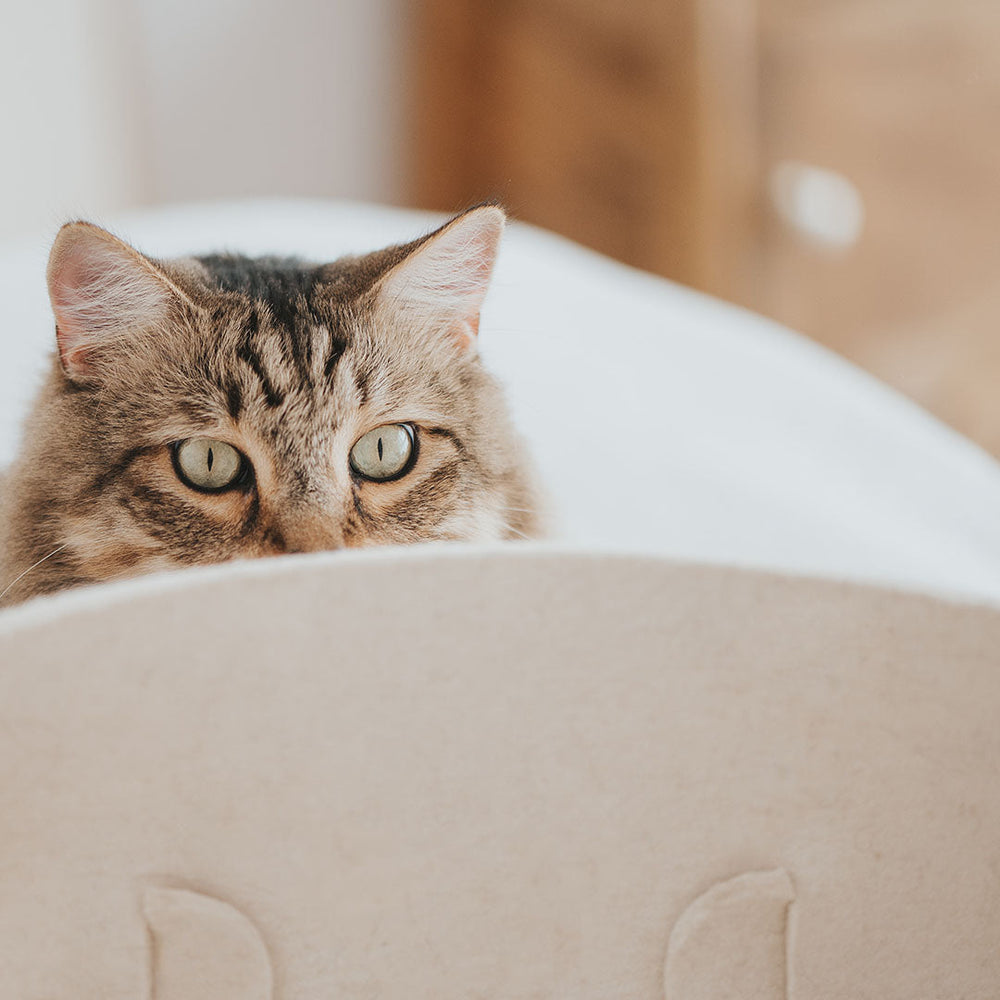
Why won’t my cat sleep in their bed?
Reading time: 7 minutes
A cat who ignores a new bed is not necessarily rejecting it. They may simply be looking for a place that better matches their instincts, habits, and sense of security.
You chose a bed that looks comfortable, found what seemed like the perfect place for it, and perhaps even added a soft cushion. Yet your cat continues to sleep on a chair, inside a cardboard box, on a pile of clothes, or directly on your desk.
This behavior can be disappointing, but it is rarely impossible to explain. Unlike humans, cats do not choose a resting place based only on how soft or attractive it appears. They also consider its location, temperature, scent, shape, and whether it allows them to observe what is happening around them.
The best cat bed is therefore not necessarily the one that looks most comfortable to us. It is the one that respects the way the cat already chooses to sleep.
A bed alone does not create a good resting space
When choosing a cat bed, we naturally focus on the product itself: its material, size, padding, and appearance. For a cat, however, the environment surrounding the bed may be just as important.
A secure resting place is generally private, protected, and sometimes slightly elevated. It should allow the cat to withdraw, relax, and maintain some awareness of their surroundings. Cats also tend to appreciate having several resting places throughout the home rather than one location chosen for them.
A beautiful bed placed in the wrong location may therefore be less appealing than a simple blanket positioned where the cat already feels comfortable.
Before deciding that your cat does not like their bed, observe the places they choose naturally. Do they seek height? Sunlight? Proximity to their humans? A secluded corner? A firm surface rather than a deeply padded cushion?
Their existing choices often contain the answer.
The location may not feel right
A bed placed in a busy area may seem practical to us, but feel too exposed to a cat. An entryway, hallway, playroom, or space near a noisy appliance may make deep rest more difficult.
Cats generally need calm surroundings to sleep comfortably. A quiet corner of the living room, bedroom, or office may be more inviting than an area where people are constantly passing by. The bed should also be protected from drafts without being placed directly beside an intense heat source.
It is usually best not to position a resting space directly beside the litter box, food, or water. Important resources are often more comfortable for cats when they are separated and when several options are available throughout the home.
Rather than trying to convince your cat to sleep where you placed the bed, try the opposite: temporarily move the bed to a location they already use.
Some cats prefer sleeping up high
For cats, height is not simply a decorative preference. It allows them to observe their surroundings, anticipate movement, and stay away from certain disturbances.
A bed placed on the floor may therefore be ignored, while the same bed positioned on a stable surface—such as a console table, wide shelf, low cabinet, or corner of a desk—may suddenly become much more appealing.
Many MATT™ customers place the basket on their desk. Their cat can remain close, observe the room, and quietly take part in everyday activities without necessarily being at the center of the action.
Accessibility remains important. For kittens, senior cats, or cats with reduced mobility, choose a height that is easy to reach and a surface that is wide and stable enough to be safe.
The bed may still smell new
Scent plays an essential role in the way cats evaluate their environment. A familiar smell can signal safety, while a new object carries several unfamiliar scents: material, packaging, storage, transportation, and handling.
Even when these odors seem subtle to us, they may make the bed feel less reassuring at first.
You can temporarily place one of the following inside the bed:
- a small blanket your cat already sleeps on;
- a familiar toy;
- a piece of clothing carrying your scent;
- a cushion or textile from one of their usual resting places.
There is no need to perfume the bed or use strongly scented products. Artificial fragrances and heavily scented cleaners may interfere with the cat’s familiar scent markers.
The goal is not to hide the smell of the new bed, but to gradually integrate it into the familiar scent landscape of the home.
The shape may not match the way your cat sleeps
Not all cats sleep in the same position.
Some curl into a tight ball and seek edges they can lean against. Others prefer to stretch out fully, sleep on their side, or change positions frequently. Some cats favor a firm surface, while others look for more cushioning.
A very large bed may seem generous, but it may feel less secure to a cat who likes being gently enclosed. On the other hand, a bed that is too small may restrict a cat who prefers to stretch out.
The ideal size therefore depends on more than the animal’s weight or length. Their sleeping habits are often more revealing than their measurements.
Observe your cat while they sleep naturally:
- Do they curl up inside small spaces?
- Do they lean against a wall, cushion, or the edge of the sofa?
- Do they leave their paws hanging outside?
- Do they frequently change position?
- Do they prefer firm or soft surfaces?
These behaviors can help you understand whether your cat prefers a defined space, an open surface, or an additional layer of comfort.
Temperature also influences their choice
Cats often seek warm and comfortable places, such as a patch of sunlight, a blanket fresh from the dryer, or a space near a heat source. Their preferred location may change, however, depending on the season, time of day, and room temperature.
A bed that is used regularly in winter may be temporarily ignored during warmer weather. The cat may return to it as soon as temperatures drop.
Material and padding also affect the experience. Some cats prefer a very soft cushion, while others choose a firmer and more breathable surface. It can therefore be useful to offer the bed without a cushion at first, then try adding a thin blanket or removable cushion.
This helps reveal what the cat actually prefers rather than assuming that more padding automatically means greater comfort.
Cats naturally change sleeping locations
A cat may use the same bed for several weeks and then suddenly begin sleeping somewhere else. This does not necessarily mean they no longer like it.
Cats often move between several resting places. They may seek sunlight in the morning, a cooler location in the afternoon, proximity to their human during work hours, and a more secluded space in the evening.
The bed does not need to be used constantly to remain useful. It may simply be one of several places the cat chooses according to their needs at a particular moment.
That freedom of choice matters. For a cat, comfort also comes from being able to decide where, when, and how they want to rest.
In a home with multiple cats
In a multi-cat home, a bed may appear available without feeling truly accessible to every cat.
A more confident cat may occupy the space, watch the surrounding area, or subtly prevent another cat from approaching. Visible fighting is not required. Some cats simply avoid a resource when they do not feel entirely safe using it.
Providing several resting places in separate areas can make a significant difference. Ideally, each cat should be able to access a secure resting place without having to pass close to another animal or share a resource they would rather use alone.
In this situation, moving the bed to another room or adding a second resting space may help.
Your cat may simply need time
Some cats explore a new object immediately. Others observe it for several days before approaching.
It is best to leave the bed accessible without repeatedly placing the cat inside it. Forcing them into the bed may create a negative association and remove the sense of control that contributes to their comfort.
Instead, allow the bed to become a normal part of the room. Add a familiar scent, place it near a location they already enjoy, and let the cat discover it at their own pace.
A bed ignored for several days can suddenly become a favorite place without any particular intervention.
How can you encourage your cat to use their bed?
Begin by observing rather than making several changes at once.
Place the bed somewhere your cat already sleeps, even when it is not the location you originally imagined. Add a familiar blanket or object. Make sure the area is calm, accessible, and sufficiently protected.
You can then test one adjustment at a time:
- move the bed near a window or into a quieter corner;
- place it slightly higher on a safe and stable surface;
- remove or add a cushion;
- change its orientation so your cat can better observe the room;
- provide another resting place in a different area of the home.
Changing only one element at a time makes it easier to understand what is actually influencing their choice.
Try not to turn the bed into a highly active play area or keep food inside it permanently. The goal is to preserve its association with calm, rest, and safety.
When does a change deserve more attention?
A cat who has never used a new bed is generally expressing a preference. A cat who suddenly avoids a resting place they previously used regularly may be communicating something else.
For senior cats, difficulty jumping, stepping over high sides, or reaching an elevated location may be related to reduced mobility or joint discomfort.
A veterinary consultation may be appropriate when the change is sudden or accompanied by other signs, such as reduced appetite, increased isolation, unusual vocalization, difficulty moving, or a significant change in sleeping habits.
What inspired the MATT™ Basket
The MATT™ Basket began with the observation of a simple behavior: the instinctive attraction many cats have to cardboard boxes.
A cardboard box is not padded and does not resemble the human idea of a comfortable bed. Yet it provides something important to a cat: a defined form, reassuring edges to lean against, and a slightly enclosed space where they can rest while still observing their surroundings.
Kim Landry, architect and founder of MATT™, wanted to preserve that simplicity while creating an object that was more durable, easier to care for, and better suited to the home.
The basket was therefore designed from a single sheet of high-density natural wool felt. Precise cuts and carefully considered folds allow the flat material to become a stable structure without built-in padding. It can be used on its own by cats who prefer a firmer surface or completed with a removable cushion for those who enjoy additional softness.
Its lightweight construction also makes it easy to move according to the cat’s habits: near a window, on a desk, in a quiet corner of the living room, or in the bedroom.
Because a good resting space should not simply impose a form. It should adapt to the way the animal actually chooses to live within the home.
A final thought
When a cat ignores a new bed, our first instinct is often to question the product.
The answer, however, may be found elsewhere: in its location, scent, temperature, height, or the animal’s established habits.
A cat does not necessarily choose the most beautiful or most heavily cushioned bed. They choose the place where they feel secure enough to lower their guard and rest.
Before replacing the bed, it may therefore be helpful to look at the home from the cat’s perspective.
The right resting space is not simply an object.
It is the meeting point between a form, a material, a location, and the preferences of one unique animal.
Related articles
- Why do cats love boxes so much?
- Why do cats sleep curled up?
- How to choose the right bed size for your cat
- Why do cats love high places?
- Why do cats love sleeping in the sun?
- Why does wool feel so familiar to cats?
Related products
- MATT™ Pet Basket
- Minimalist Cushion for the MATT™ Basket
- Premium Cushion for the MATT™ Basket
- MATT™ Pet Collection
About MATT™
MATT™ is a brand founded by architect Kim Landry.
Through The MATT™ Journal, we explore animal behavior, natural materials, and thoughtful design to better understand what inspires each of our objects.
We believe the best products always begin with a deeper understanding of those who use them.